
Car Manufacturing: Costs & Best Practices for Production Line Setup
Presented by Amindus Consulting and Solutions
Setting up a car manufacturing production line requires a significant investment, and the costs vary widely depending on the type of vehicle, production capacity, and level of automation. Internal combustion engine (ICE) vehicles and electric vehicles (EV) have distinct manufacturing needs, which influence the machinery, equipment, and sourcing strategies involved.
This post breaks down the key investment areas, highlights differences between ICE and EV production lines, and offers practical advice on budgeting and sourcing to help investors and manufacturers make informed decisions.

Investment Costs Based on Production Capacity and Automation Levels
The initial investment for a car manufacturing line depends heavily on the planned production volume and the degree of automation. Smaller plants with limited automation may cost tens of millions of dollars, while large, fully automated facilities can exceed a billion dollars.
Low to Medium Capacity (10,000 to 50,000 units/year)
These plants often combine manual labor with some automated processes. Investment ranges from $50 million to $200 million. The focus is on flexible equipment that can handle multiple models with moderate speed.
High Capacity (100,000+ units/year)
High-volume plants rely on extensive automation, including robotic welding, painting, and assembly. Costs typically start around $500 million and can go beyond $1 billion. These lines require advanced machinery to maintain efficiency and quality at scale.
Automation Levels
- Manual or Semi-Automated: Lower upfront costs but higher labor expenses and slower production rates.
- Fully Automated: Higher capital expenditure but reduced labor costs and consistent quality. Automation also allows faster scaling and better data integration for quality control.
Choosing the right balance depends on the target market, labor costs, and long-term production goals.
Key Production Stages and Their Cost Drivers
Car manufacturing involves several critical stages, each with unique equipment and investment requirements.
Stamping
Stamping shapes metal sheets into body panels. It requires heavy presses, dies, and tooling.
Investment Factors
- Number of dies needed for different parts
- Press capacity and speed
- Material handling systems
Cost Range
Small stamping lines start around $10 million; large automated stamping facilities can exceed $100 million.
Body Welding
This stage joins stamped parts into a vehicle body using spot welding, laser welding, or adhesive bonding.
Machinery
- Robotic welding arms
- Welding power supplies
- Fixtures and conveyors
Cost Considerations
Automation level greatly affects cost. Fully robotic welding lines can cost $50 million or more.
Painting
Painting involves surface preparation, coating, and curing.
Equipment Needed
- Pretreatment tanks
- Paint booths with robotic sprayers
- Drying ovens
Investment Range
Painting lines are expensive due to environmental controls and precision requirements, often costing $50 million to $150 million.
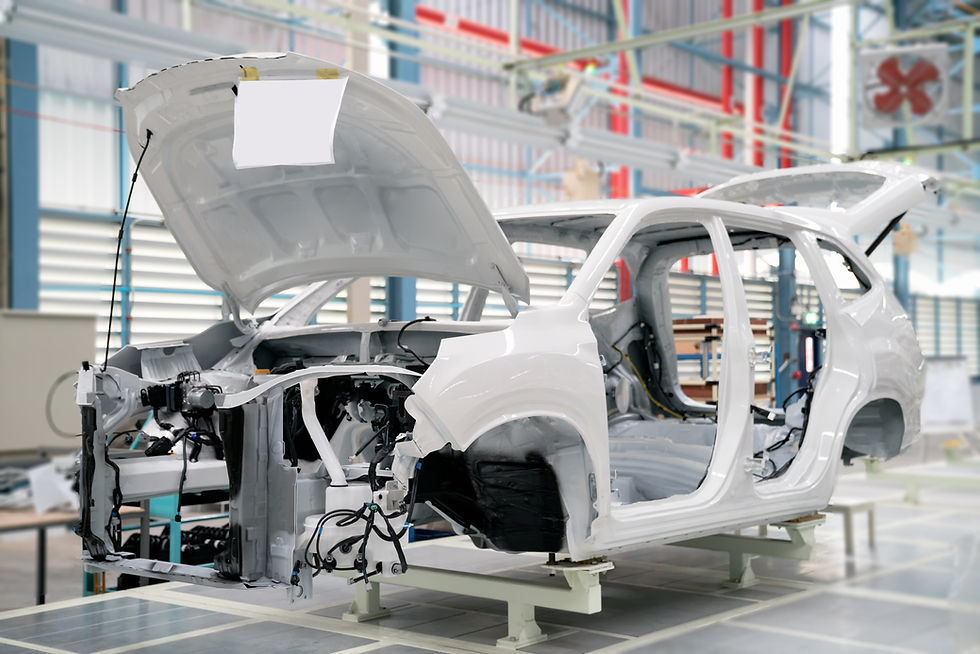
Final Assembly
This stage installs engines, electronics, interiors, and other components.
Key Investments
- Assembly stations and conveyors
- Testing and inspection equipment
- Specialized tools for engine and battery installation
Cost Factors
Final assembly costs vary widely, typically $50 million to $200 million depending on automation and complexity.
Differences Between ICE and EV Production Lines
While ICE and EV vehicles share some production stages, their manufacturing lines differ significantly in machinery and component handling.
Engine vs. Battery Installation
ICE lines require engine assembly and installation stations, including fuel system integration. EV lines focus on battery pack assembly and installation, which demands specialized handling equipment due to battery size, weight, and safety concerns.
Electronics and Wiring
EVs have more complex electrical systems, requiring advanced electronics assembly and testing stations.
Chassis and Body Design
EVs often use different chassis designs to accommodate battery packs, which can affect stamping and welding tooling.
Machinery Differences
EV lines may need additional cleanroom environments for battery assembly and more precise torque tools for battery pack fastening.
Cost Impact
Battery assembly equipment can add $20 million to $50 million to the investment. EV lines may also require enhanced safety systems for handling high-voltage components.
Best Sourcing Practices for Critical Components
Sourcing key components like engines, batteries, and electronics affects both cost and production reliability.
Engines
ICE manufacturers often source engines from specialized suppliers or build in-house. Outsourcing reduces capital investment but may increase per-unit costs.
Batteries
Battery sourcing is critical for EVs. Manufacturers typically partner with established battery producers or invest in joint ventures to secure supply and reduce costs.
Electronics
Complex electronics require reliable suppliers with quality certifications. Long-term contracts help ensure steady supply and price stability.
Sourcing Strategies
- Diversify suppliers to reduce risk
- Negotiate volume discounts
- Establish quality control standards upfront
- Consider local suppliers to reduce logistics costs and lead times
Quality, Safety, and Supply Chain Considerations in Car Manufacturing
Ensuring quality and safety is essential to project success and regulatory compliance.
Quality Control
Integrate inspection stations throughout the line, including automated vision systems and end-of-line testing.
Safety
EV lines require strict protocols for handling high-voltage batteries, including fire suppression systems and worker training.
Supply Chain
Secure supply chains for critical parts to avoid production delays. Use inventory management software and maintain buffer stocks for key components.
Regulatory Compliance
Comply with environmental regulations for painting and waste disposal. Follow safety standards for worker protection.
Common Budgeting Mistakes in Automotive Manufacturing
Many projects face cost overruns due to common pitfalls:
Underestimating Automation Costs
Automation equipment is expensive and requires skilled installation and maintenance.
Ignoring Integration Expenses
Integrating machinery, software, and supply chains can add significant costs.
Overlooking Training and Workforce Development
Skilled operators and maintenance staff are essential for smooth operation.
Failing to Account for Regulatory Costs
Environmental and safety compliance can require costly upgrades.
Neglecting Contingency Funds
Unexpected delays or equipment failures can increase expenses.
Planning with realistic cost estimates and including contingency budgets improves project viability.


Comments