
Why Heat Treatment Changes the Properties of Steel and Metal Parts
Presented by Amindus Consulting and Solutions
Heat treatment plays a crucial role in shaping the performance and durability of steel and metal parts. By carefully controlling temperature and cooling rates, manufacturers can tailor the mechanical properties of metals to meet specific needs.
This post explores why heat treatment changes steel properties, the science behind common processes like annealing, quenching, and tempering, and how these methods affect hardness, ductility, and tensile strength. We will also look at real-world applications where heat-treated metals make a difference.
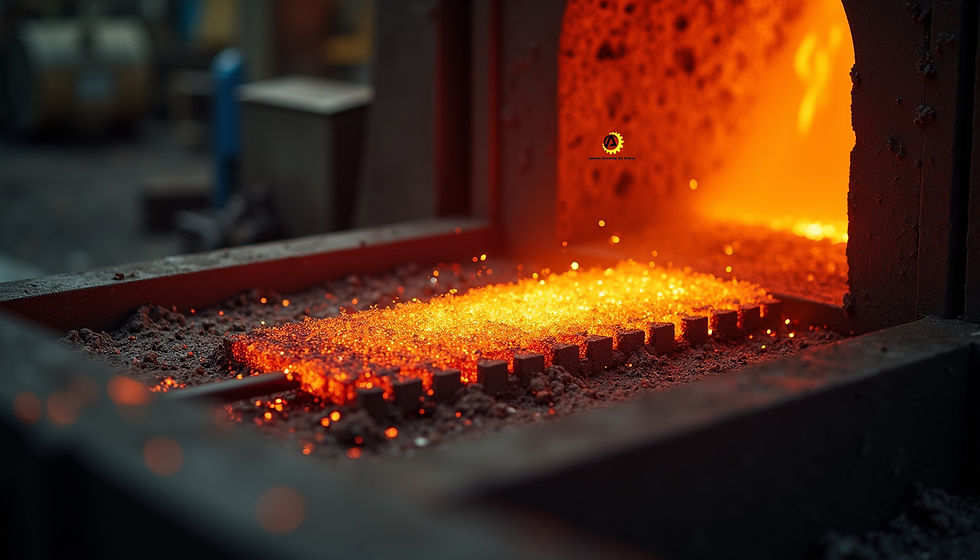
How Heat Treatment Changes Steel
Steel is an alloy primarily made of iron and carbon. Its properties depend on the arrangement of atoms and the phases present in the metal. Heat treatment alters these microstructures by heating steel to specific temperatures and then cooling it at controlled rates. This process changes the internal structure, which directly affects mechanical properties such as hardness, ductility, and tensile strength.
The key to heat treatment lies in manipulating the phases of steel, especially austenite, ferrite, cementite, and martensite. Each phase has distinct characteristics:
Austenite: A face-centered cubic structure stable at high temperatures.
Ferrite: A body-centered cubic structure, soft and ductile.
Cementite: Iron carbide, hard and brittle.
Martensite: A supersaturated solid solution formed by rapid cooling, very hard and strong but brittle.
By controlling how steel transitions between these phases, heat treatment customizes the metal’s behavior.
Annealing: Softening and Improving Ductility
Annealing involves heating steel to a temperature where austenite forms, holding it there, then cooling slowly, usually in a furnace. This slow cooling allows carbon atoms to diffuse and form a more stable microstructure, typically pearlite or ferrite and cementite mixtures.
Effects of Annealing
Reduces hardness: Softens the metal, making it easier to machine or shape.
Increases ductility: The metal becomes more flexible and less likely to crack.
Relieves internal stresses: Removes stresses caused by previous processing like cold working.
Applications of Annealed Steel
Annealed steel is common in manufacturing parts that require further shaping or forming, such as automotive body panels, pipes, and structural components. For example, steel sheets used in car manufacturing are often annealed to improve formability before stamping.
Quenching: Increasing Hardness and Strength
Quenching heats steel to form austenite, then rapidly cools it by immersion in water, oil, or air. This rapid cooling traps carbon atoms in solution, creating martensite, a very hard but brittle phase.
Effects of Quenching
Greatly increases hardness: Martensite is much harder than other phases.
Increases tensile strength: The steel can withstand higher forces without deforming.
Reduces ductility: The metal becomes more brittle and prone to cracking.
Applications of Quenched Steel
Quenched steel is used where high strength and wear resistance are critical. Examples include cutting tools, drill bits, gears, and automotive components like crankshafts. For instance, drill bits require hardness to cut through materials without dulling quickly.
Tempering: Balancing Hardness and Toughness
Tempering follows quenching. The quenched steel is reheated to a lower temperature and held there before cooling again. This process reduces brittleness by allowing some carbon atoms to diffuse out of martensite, forming tempered martensite.
Effects of Tempering
Reduces brittleness: Improves toughness and impact resistance.
Slightly lowers hardness: Balances hardness with flexibility.
Increases ductility: Makes the steel less likely to crack under stress.
Applications of Tempered Steel
Tempered steel is widely used in tools and structural parts that need both strength and toughness. For example, springs, knives, and automotive suspension components are tempered to avoid breaking under repeated stress.
How Heat Treatment Affects Key Properties
| Property | Annealing | Quenching | Tempering |
|----------------|---------------------------|-------------------------|-------------------------|
| Hardness | Decreases | Increases significantly | Decreases slightly |
| Ductility | Increases | Decreases | Increases |
| Tensile Strength | Moderate | Increases | Moderate to high |
| Brittleness | Low | High | Moderate |
Understanding these effects helps engineers select the right heat treatment for the intended use of steel parts.
Real-World Industries Using Heat-Treated Metals
Heat treatment is essential across many industries:
Automotive: Engine components, gears, and suspension parts are heat treated to balance strength and durability.
Construction: Structural steel beams and rebar are often annealed or tempered to ensure safety and flexibility.
Tool Manufacturing: Cutting tools, drills, and saw blades require quenching and tempering for hardness and toughness.
Aerospace: Aircraft parts undergo precise heat treatment to meet strict strength and fatigue resistance standards.
Oil and Gas: Drill pipes and valves are heat treated to withstand harsh environments and high pressures.
Each industry relies on heat treatment to extend the life and performance of metal parts, reducing failures and maintenance costs.
Summary
Heat treatment transforms steel by changing its internal structure through controlled heating and cooling. Annealing softens steel and improves ductility, quenching increases hardness and strength but makes steel brittle, and tempering balances hardness with toughness. These processes allow manufacturers to tailor steel properties for specific applications, from automotive parts to cutting tools.
Understanding the science behind heat treatment helps engineers and manufacturers create stronger, more reliable metal components that meet the demands of modern industries. Whether improving formability or enhancing wear resistance, heat treatment remains a cornerstone of material science and metalworking.


Comments