
How to Protect Your Company and Product Name with Trademark Registration
Presented by Amindus Consulting and Solutions
A strong name can become one of the most valuable assets in a business. It helps customers find the right product, avoid copycats, and remember why they chose it.
This guide explains how trademark registration works, how to search for name conflicts, and how to monitor your rights after registration. It is written for the U.S. market and is informational, not legal advice.

1. Understand what a trademark protects
A trademark protects a name, phrase, logo, symbol, or design that identifies the source of goods or services. A company name can be a trademark. A product name can be a trademark. A slogan can also qualify if customers connect it to one source.
A trademark does not protect the product idea itself. It protects the sign customers use to identify where the product or service comes from.
For example:
Name type | What it can protect |
Company name | The business identity used in commerce |
Product name | A specific product line or item |
Service name | A named service offering |
Logo | A visual mark tied to goods or services |
Tagline | A phrase that identifies the source |
A key point matters here. Forming a business entity with a Secretary of State does not give nationwide trademark rights. It only means another entity in that state cannot usually register the same legal business name. It does not stop a similar company in another state from using a confusing name in the market.
Domain names work the same way. Owning `example.com` does not create trademark rights by itself.
If the goal is to protect your company name across the country, federal trademark registration is usually the strongest path.
2. Choose a name that can qualify for protection
Not every name is equally strong. Trademark law favors names that help customers identify a single source.
Strong marks are easier to protect. Weak marks can be hard to register and harder to enforce.
From strongest to weakest:
Made-up names
These are invented words with no dictionary meaning. They are often strong because they point only to one source.
Unexpected names
These use a real word in an unrelated way. A fruit name for computers is a classic type of example.
Suggestive names
These hint at a benefit but do not describe the product directly.
Descriptive names
These tell customers what the product is, what it does, or who it serves. These are harder to protect.
Generic terms
These are common names for the product or service itself. They cannot be owned as trademarks.
A practical test helps. Ask whether competitors need the same words to describe their own goods. If the answer is yes, the name may be too descriptive.
For a product launch, this step matters early. It is cheaper to adjust a name before packaging, labels, domains, launch materials, and customer reviews exist. Once a weak name gains traction, changing it becomes costly.
3. Search for conflicts before you commit
A name search is the best way to reduce risk before filing a trademark application or launching under a new name.
The goal is not only to find exact matches. The bigger risk is a name that is close enough to confuse customers. Trademark conflicts can exist when names look alike, sound alike, mean something similar, or cover related goods and services.
A strong search should cover several sources.
Search the federal trademark database
Start with the United States Patent and Trademark Office, often called the USPTO. Its trademark search tool shows pending applications and registered marks.
Search for:
Exact matches
Similar spellings
Plural and singular versions
Shortened versions
Phonetic matches
Translated meanings, if relevant
Similar names in related product or service categories
Do not stop when the exact name is clear. A coffee brand called “Kado” could still face issues with “Cado” if both sell beverages and customers may confuse them.
Search state business records
Check Secretary of State databases in key states. Start with the state where the business operates, then states where sales are planned.
State records do not reveal all trademark issues, but they can expose companies already using similar names.
Search domain names and app stores
Look for matching and similar domain names. Also check major app stores if software, mobile services, or digital products are involved.
This does not replace a trademark search, but it can reveal active use in the market.
Search marketplaces and online retailers
If the product will sell through retail platforms, search those platforms. Look for sellers using similar company or product names.
Also check category pages, product titles, and seller names. A name may not appear in a federal filing but may still be used in commerce.
Search the open web
Use search engines to look for the name in quotes and without quotes. Search likely misspellings. Add product category words.
For example:
`"Name" skincare`
`"Name" supplements`
`"Name" software`
`"Name" consulting`
`"Name" store`
If results show a business using a close name for related goods, treat it as a warning sign.
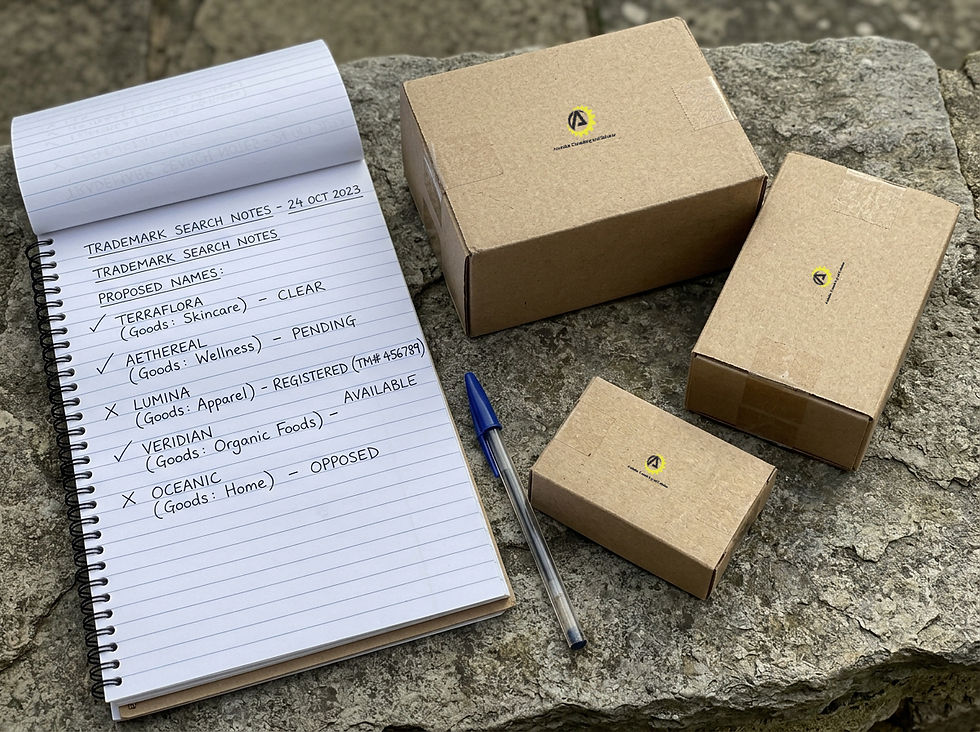
4. Compare the names the way customers would
A conflict analysis is not just a legal database exercise. Ask how real customers would react.
Focus on these questions:
Do the names sound alike when spoken?
Do they look alike on labels, receipts, or search results?
Do they create the same impression?
Are the goods or services related?
Do both companies sell through the same channels?
Could one company appear to sponsor or approve the other?
Are customers likely to assume a connection?
Related goods can create risk even if they are not identical. A name used for energy drinks may conflict with a similar name used for nutrition bars. A software name may conflict with a similar business service if buyers overlap.
If the name survives this review, the next step is filing.
5. File the right trademark application
Federal registration gives stronger rights than common-law use alone. Common-law rights can arise from actual use in commerce, but they are often limited to the geographic area where the name is known.
A federal registration can provide:
A public record of ownership
Legal presumptions of validity and ownership
Nationwide rights tied to the listed goods or services
The ability to use the registered trademark symbol after registration
A stronger basis for stopping confusing use by others
A record that can help with online platform complaints and takedown requests
The filing process has several parts.
Identify the owner
The owner should be the person or legal entity that controls the quality of the goods or services. This may be a limited liability company, corporation, or individual owner.
File under the correct owner. Fixing ownership mistakes later can be difficult.
Choose the goods and services
The application must describe what the mark covers. This is not a place to list every future dream. The description should match actual or planned use.
Trademark applications also use classes. A class groups types of goods or services. For example, clothing, software, cosmetics, and consulting services usually fall into different classes.
Choose a filing basis
For U.S. applications, many filings use one of two bases:
Use in commerce The name is already being used to sell goods or services across state lines.
Intent to use The name is not in use yet, but there is a real plan to use it.
An intent-to-use filing can help reserve a place in line, but registration does not issue until proof of use is accepted.
Submit a specimen
A specimen is real proof of how the mark appears in commerce. For goods, this might be packaging, labels, or a product page with a purchase option. For services, it may be a web page or brochure showing the mark used with the service.
The specimen must match the mark and the listed goods or services.
Respond to examiner questions
After filing, a government examining attorney reviews the application. They may approve it, refuse it, or ask questions. A refusal can involve confusion with an earlier mark, a descriptive name, or problems with the description or specimen.
Some issues can be fixed. Others may mean the name is too risky.
6. Use the name correctly after filing
Trademark rights rely on proper use. Sloppy use can weaken a mark.
Use the name as a source identifier, not as the generic product name. For example, write the product name followed by the generic term.
Good use:
`BRIGHTVALE` accounting software
`NORTHPIN` trail shoes
`LUMAFARE` meal kits
Weak use:
“Buy a brightvale”
“We sell northpins”
“Try this lumafare”
Use the trademark symbol correctly:
Use ™ for an unregistered mark used with goods or services.
Use ℠ for an unregistered service mark, though many businesses use ™ for both.
Use ® only after federal registration issues.
Do not use ® while an application is pending. That can create legal problems.

7. Monitor for similar names
Registration is not the final step. Trademark offices do not police the market for you. Owners must watch for confusing uses and act when needed.
Brand monitoring should cover:
New federal trademark applications
State business filings
Domain registrations that copy or closely match the name
Online marketplaces
App stores
Search results
Industry directories
Trade shows and product catalogs
Customer reports of confusion
A simple tracking system helps. Create a monthly checklist. Save screenshots with dates. Keep links, seller names, product listings, and examples of customer confusion.
For larger brands, a watch service can track new trademark filings and similar names. For small companies, a mix of calendar reminders, saved searches, and platform alerts can work at the start.
The goal is to catch problems early. A small seller using a confusing name may be easier to address before the name spreads, gains reviews, or files its own trademark application.
8. Enforce your rights in a measured way
Enforcement should match the risk. Not every similar name deserves an aggressive response.
Start by asking:
Is the other use in the same or a related market?
Is there real customer confusion?
Is the other business local, national, or online?
Did the other use start before yours?
Does the use weaken or damage the name?
Is it a fair descriptive use of ordinary words?
Common enforcement steps include:
Document the use
Save screenshots, product photos, listings, packaging, and dates.
Review the legal position
Confirm ownership, registration status, first use dates, goods or services, and market overlap.
Send a measured letter
A demand letter can ask the other party to stop using the name or make changes. Keep the tone professional and specific.
Use platform complaint tools
Many marketplaces, app stores, and domain services have complaint systems for trademark issues.
Negotiate a coexistence agreement
If confusion is unlikely, both parties may agree on boundaries. For example, one party may avoid certain product categories or regions.
Consider formal legal action
Lawsuits are costly. Use them when the harm is serious and other options fail.
Overenforcement can backfire. A weak claim may damage reputation and waste money. A clear, well-documented claim has a better chance of success.
9. Know the risks of doing nothing
Failing to protect a name creates legal, financial, and reputational risk.
The most common problems include:
A competitor registers a similar name first.
A marketplace removes listings after a complaint.
Customers buy from a copycat by mistake.
Investors question whether the business owns its key assets.
A rebrand becomes necessary after growth.
Packaging, labels, domains, and software assets must be replaced.
Reviews and customer trust get split between similar names.
Legal disputes consume time and cash.
Rebranding after launch can be painful. It affects inventory, packaging, web pages, customer support, contracts, bank records, and search visibility. It can also confuse loyal customers.
A trademark dispute can also freeze expansion. Retailers, distributors, and partners often ask whether the company owns or can use its name. A pending conflict can slow those talks.
This is why name protection belongs near the start of the business planning process, not after the first demand letter arrives.
10. Build a practical brand protection checklist
Use this checklist before launch and after registration.
Before launch:
Pick a name that is not generic or highly descriptive.
Search federal trademark records.
Search state business databases.
Search domains, marketplaces, app stores, and the open web.
Review similar names from the customer’s point of view.
Check that the name works for planned goods or services.
File before investing heavily in packaging or promotion.
After filing:
Track application deadlines.
Respond on time to government questions.
Use the name consistently.
Keep proof of use.
Watch for similar names.
Save evidence of confusion.
Enforce rights in a measured way.
Renew the registration when required.
This same process applies when you need to protect your product name before a new line, app, course, or consumer item reaches the market.

FAQ
Do I need a trademark if I already registered my business name?
Yes, if you want stronger rights in the market. A state business registration allows the entity to exist under that name in that state. It does not give full nationwide trademark protection.
Can two companies have the same name?
Yes, in some cases. The risk depends on the goods or services, location, customers, and whether people are likely to confuse the two businesses. A bakery and a software tool may be able to share a name if customers would not assume a connection.
When should I file a trademark application?
File before major launch costs when possible. Early filing can reveal problems before packaging, domains, and customer awareness grow around a name.
How long does trademark protection last?
Federal trademark rights can last as long as the mark stays in use and the owner files required maintenance documents on time. Missing deadlines can lead to cancellation.
Can I handle trademark registration myself?
Some simple filings can be handled by business owners. Complex searches, refusals, multi-product filings, and enforcement issues often call for a trademark attorney.
Make name protection part of the launch plan
A company name or product name should not be treated as a last-minute creative choice. It needs legal clearance, proper filing, consistent use, and active monitoring.
The process is straightforward:
Choose a strong name.
Search before launch.
File the right application.
Use the name correctly.
Monitor the market.
Enforce rights when needed.
For more discussion on protecting business assets and handling name conflicts, visit the Amindus Consulting forum.
A protected name gives the business room to grow without avoidable disputes. Start before the name becomes expensive to change.




Comments